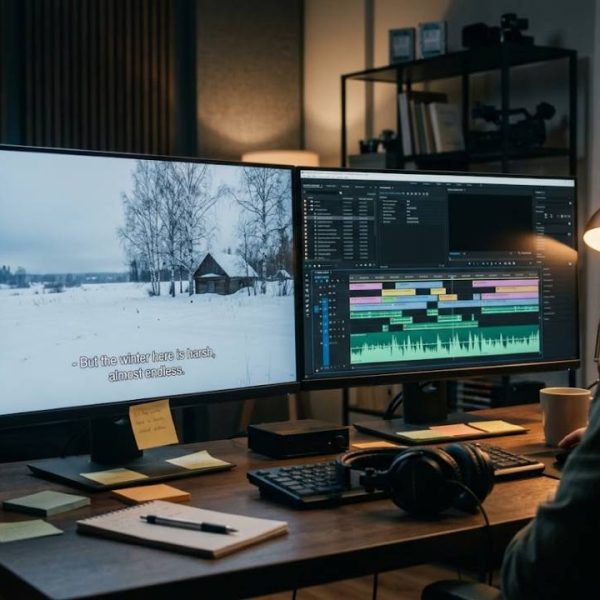
A Russian documentary can be visually stunning and still fall flat abroad. The footage travels without effort. The words do not. For an English-speaking viewer, everything depends on a thin line of text at the bottom of the screen, and that line has about two seconds to do its job.
Subtitling Russian films for English audiences looks simple from the outside. Translate the dialogue, time it, export the file. In practice it is a craft built on hundreds of small decisions, and the quality of those decisions decides whether a festival jury, a streaming buyer or a classroom stays with the film or switches off.
Why Russian is a tough pair for subtitles
Russian and English are built very differently. Russian uses cases, flexible word order and long compound expressions. A single spoken sentence in a documentary interview can run for twenty seconds, wander through three ideas and end with a verb that changes the meaning of everything before it.
English subtitles cannot wait for that verb. A viewer reads line by line, in real time, so the subtitler has to anticipate where the speaker is going and split the sentence into units that make sense on their own. That is why good russian to english translation for the screen is less about finding equivalents and more about rebuilding the thought in a shape English readers can follow.
Then there is length. Russian text often runs longer than its English version, but spoken Russian in interviews is dense and fast. Subtitlers regularly cut 30 to 40 percent of the spoken words without losing meaning. Knowing what to drop, and what must stay, is the real skill.
Reading speed comes first
Every subtitle file is a negotiation between the speaker and the viewer's eyes. Most broadcasters set a limit on characters per second, and the numbers are strict. The BBC subtitle guidelines, for example, are a widely used reference for line length, timing and how long a subtitle should stay on screen.
For a documentary, these limits shape the translation itself. A subtitler will:
- condense repetitions and filler words typical of spoken Russian
- merge short replies into one readable subtitle
- keep line breaks at natural grammar points, never between an adjective and its noun
- leave enough frames between subtitles so shot changes do not cause flicker
When these rules are ignored, viewers end up reading instead of watching. In a documentary, where the images carry half the story, that is a real loss.
Names, titles and transliteration
Russian documentaries are full of names, places, patronymics and institutions. Each one raises a question. Should a speaker be "Ivan Petrovich" or simply "Ivan"? Is it "Yekaterinburg" or "Ekaterinburg"? Should an acronym of a Soviet institution be spelled out, translated or explained?
Consistency matters more than any single choice. A professional team builds a short style sheet before the first subtitle is written. It lists transliteration rules, preferred spellings of names and how lower thirds and on-screen captions will be handled. This sheet keeps the whole film coherent, even when several translators work on different reels.
Humour, irony and what is left unsaid
A large part of Russian conversation lives between the lines. Interviewees use proverbs, references to Soviet films, irony that sounds almost like sincerity, and swearing that carries very different weight from its English counterpart.
Translating these moments word for word usually fails. A proverb about wolves and sheep may need to become a short English idiom, or simply a plain statement of what the speaker means. Profanity may need to be softened or strengthened depending on the audience and the distributor's guidelines. The goal is the same reaction, not the same words.
This is also where many productions go wrong. Rushed files, machine output with no human review and translators who never watched the footage lead to common subtitle translation mistakes that viewers notice immediately and share online.
On-screen text and archive material
Documentaries rarely rely on speech alone. There are newspaper clippings, handwritten letters, street signs, archive footage with Soviet-era captions and maps. Each piece of on-screen text needs a decision: subtitle it, add a forced narrative caption, or leave it if it does not affect understanding.
Archive audio is another challenge. Old recordings are noisy and speakers overlap. A careful transcript in Russian, checked against the picture, is the foundation for any accurate English version. Skipping this step is the fastest route to errors.
The workflow that works
Studios that release Russian documentaries internationally tend to follow a similar process:
- Transcription of the Russian audio, including speaker names and time codes.
- Translation into English by a native English linguist who understands Russian culture.
- Spotting and timing to the picture, respecting shot changes and reading speed.
- Review by a second linguist who watches the full film with subtitles on.
- Technical QC of the final file in the format the platform requires, such as SRT, TTML or EBU-STL.
Each stage catches different problems. Transcription errors become translation errors, and timing errors make good translation unreadable. Skipping one step to save a few days often costs far more in redelivery.
Festivals, streaming and education
The destination changes the brief. A festival screener needs fast, accurate subtitles that do justice to the director's voice. A streaming platform will have its own technical style guide, character limits and naming rules. An educational distributor may want subtitles that are slightly fuller, so students can follow complex historical context.
Knowing this from the start saves time. The best subtitle files are written for a specific audience, not for an abstract viewer.
Bringing Russian stories to new viewers
Russian documentary makers have a long tradition of patient, observational storytelling. When the subtitles respect that rhythm, English-speaking audiences can experience the film almost as the director intended. When they do not, even the best footage feels distant.
The difference lies in preparation, cultural knowledge and a clear workflow. For producers planning an international release, investing in experienced subtitlers and translators is one of the simplest ways to make sure the story reaches the people it was made for.
Technology is starting to change parts of this craft as well. AI tools can now draft a first pass of subtitles for tech videos and similar content in a fraction of the usual time. The catch is the same one this article warns about throughout: speed without human review produces exactly the mistakes viewers love to screenshot. The strongest results come from pairing fast automated drafts from subtitling services with a linguist who checks tone, timing and cultural fit.